Friday, October 21, 2011

Nudity and the family

I have a question for everyone.  It stems from a discussion that I had with a certain someone who mentioned to me that her husband will cover up his bits anytime he's naked in front of his baby, a little boy.  I laughed and remembered Billy telling me the story about how a few times, while he was showering with Desmond in the morning, Desmond has pointed to Billy's penis and reached out to touch it.  It made Billy uncomfortable (and rightly so), and that started our discussion about how we wanted to approach nudity in our family.

I'm pretty comfy in my own skin at home.  I grew up used to seeing my mom naked...I would sit at the edge of the jacuzzi tub my mother had in her master bathroom (what 80s house didn't?) and watch her put her bra and panties on, roll on her deodorant, spray herself with perfume, and put makeup on.  It was all a very glamorous procedure.  I remember one time asking my mom while she was nursing John, my little brother, if milk came out of both breasts, and she told me, yes, that chocolate came out of one breast and regular out of the other.  To this day, whenever I go visit her or she comes and visits me, we have no qualms about getting changed in front of each other.  I also have no qualms about getting changed in front of my friends.  I grew up in the ballet world where the changing rooms are often segregated by sex (but really, there would be danseurs (male dancers) walking around not caring a flip if they saw a boob or two (but I would always try not to stare at the little jock strap things that showed their bums)) and quick changes happen in and out of tutus in the wings.  I learned to value the beauty of the male and female form and am not unnecessarily distressed when I see nudity in public (or on TV (hellooo True Blood)).  And I definitely am comfortable walking around naked in front of Desmond.

But, to tell you the truth, I see images like this and I get uncomfortable:

SOURCE
Why?  I'm not sure.  Maybe it's the age of the children and the fact that the little boy and girl are old enough to understand that mommy and daddy are naked.  I think about the fact that I, to my knowledge, never saw my dad naked (or at least I don't remember it) and I'm definitely OK with it.  I don't think that I would like to remember what my dad looks like naked.  And I know that Billy doesn't remember seeing his dad in the nudey, but his mom said that he did.  Would I want Desmond seeing me naked as he gets older?  I'm not sure.  Part of me is like, "what's the big effing deal?"  but then the other part of me thinks about that one episode on CSI where this kid is in the psychiatric unit because he had a weird relationship with his mom.  I'm not sure what the effect is on growing children and I sure as hell don't want Desmond to have any weird things going on about nudity or sexuality or anything.

I'm conflicted because I believe that I have grown up in a culture/society that puts a LOT of emphasis on the naked form in a sexual context.  For example, I believe that women's breasts are meant to breastfeed.  Period.  A woman's vagina is another story.  Therefore, I am much more willing to accept images of women's breasts or seeing them in person than a woman's in-betweens.  I would feel completely comfortable if Desmond, at any age, saw my breasts while I was breastfeeding my other children, but wouldn't feel comfortable with him seeing me completely naked once he has the ability to remember seeing me naked.  But why?  There are so many cultures where nudity (especially showing the breasts) is commonplace and normal.  In other cultures, showing so much as a sliver of calf is considered to be taboo.  Is there a psychological change that children go through where modesty becomes an important part of their identity and nudity, on behalf of their mom and dad, makes them uncomfortable or causes them to be confused about nudity in sexual terms?  Are there any studies about this out there that anybody knows of?  Is it more appropriate that children see only the parent that's the same sex of them naked and then only up until the age where they can start recalling things?  Should dads be naked around their sons for less time than mothers around their daughters?

What do you guys do in your house?  Was there an age for your child that you stopped being naked around them?  How did your experiences growing up with nudity in your family affect your decision-making now?

Saturday, October 15, 2011

How a 14-month-old plays with other children

In 2 words: He doesn't. 

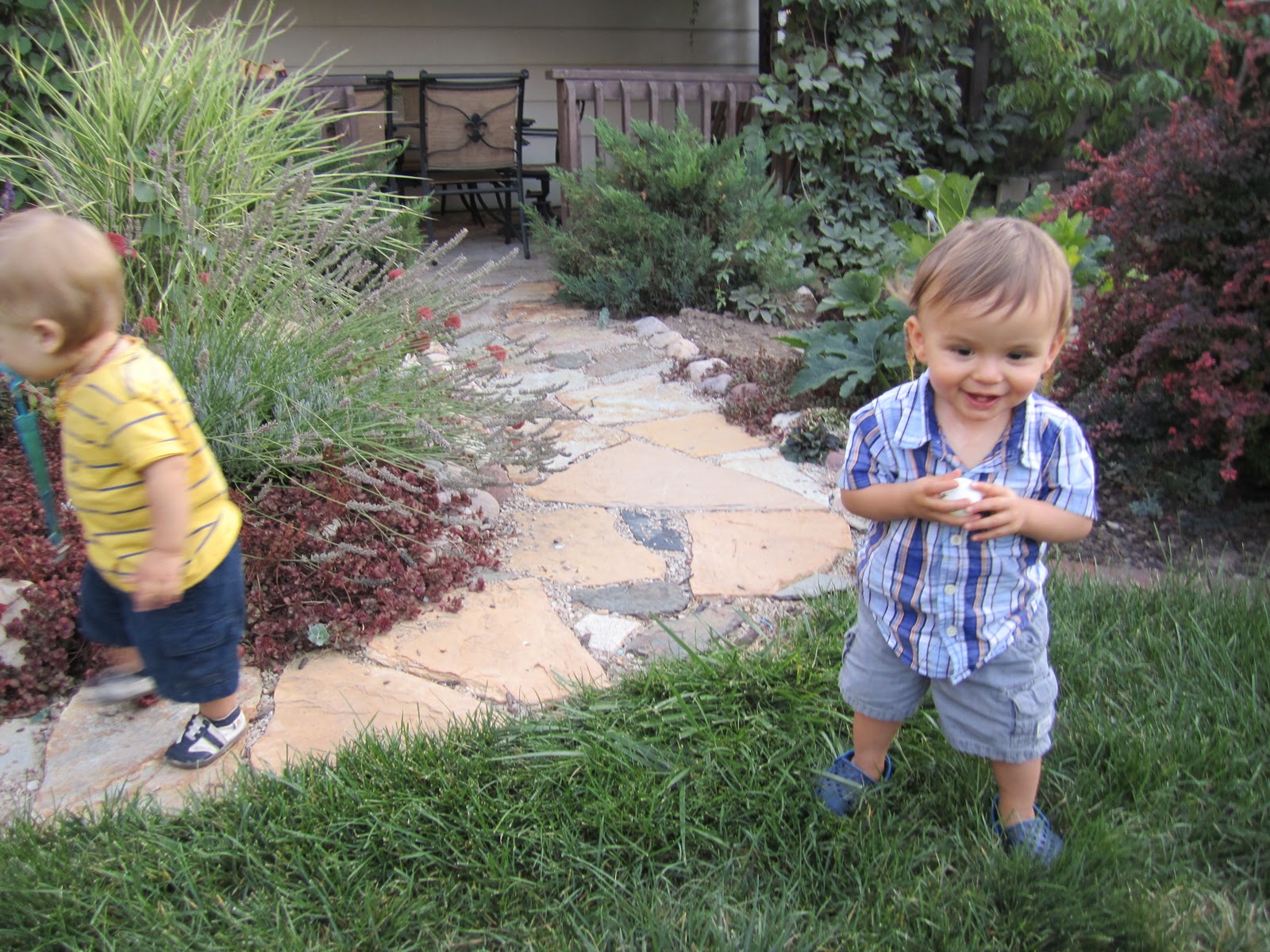
Watching, somewhat callously, as his friend Alexander falls off his chair. 
He then proceeded to take Alexander's chair.

Notice that he's not throwing the ball in Nico's direction at all.  

Walking away from a totally decent game of maybe, coulda-been catch.

Watching, impatiently, as a younger baby takes up "his" stair space.
Kids this age don't play together, they play side-by-side.  They hardly interact until they see shiny toy A in child B's hands.  Then it's all out war and all sense of politeness and propriety is thrown out the door.  Desmond will grab the toy and wrestle it from his poor "friend's" hands.  And then when the friend exacts retribution, Desmond screams as if this were the greatest injustice in the world.

When do they start learning to share?  Is it still too early to teach him?

A frolic in the ocean


Billy said this to me tonight and I laughed so hard, wine almost came out my nose.  I mean, frolic?  Who says that besides pretentious Englishmen talking about their holiday on the coast?  He was explaining to me how hard it was to learn how to boogey board and how that experience made him kind of afraid of the ocean.  His harrowing experience made me think about my 2-week-long stint as a full-time, 14-hour-a-day, stay-at-home mom while he was attending his orientation classes at Wash U.  And it was just like being tossed and turned over in a great big wave of water, not knowing where was up and when I was, if I was, going to get to the top to take a breath.  Yes, folks, it sounds overdramatic, but let me just say this: being a stay-at-home mom (or SAHM in mommy blog parlance) is no effing frolic in the ocean.

I've been lucky enough to have had a ton of help with Desmond: 2 very wonderful and competent nannies, Grandparents living nearby (well now not so nearby), and Billy having a job that allowed him the flexibility to go in late (so that I could catch a few hours of sleep undisturbed in the morning).  Plus,  I enjoyed the relative flexibility of being a part-time student (which made me a part-time stay-at-home mom, or SAHM for short).  For the first 5.5 months of Des's life, I would spend 8-10 hours with him during the day.  Those were dark times, my friends.  I had no energy to put him in the sling and take him places.  Oprah and Ellen were my dear friends during the day and any hours not spent trying to nurse, change, or placate Desmond were spent watching TV (watched every conceivable episode of CSI) and doing homework.  Looking back, I should have sucked it up and spent my time outside...at a park, walking around, etc.  But seriously, when it's all you could do to change your underwear that day, getting out the front door alone as a first-time mom with a bitty newborn is more than my mind could handle.

Sometimes I need a little help to get through the day.  Somedays, it takes the form of drinkable yogurt (mmmm...Kefir), others it's Burnt Caramel Rooibos tea with 2 ginger cookies.  And some days you just gotta throw your hands up in the air and have a nice glass of red wine.  


When Maria, our old nanny, came into our lives, it took such a weight off of my shoulders.  She adroitly took Desmond from my arms and, for the next 6 months, took such expert care of him.  I was now able to do stuff without having Desmond on my hip constantly needing my attention.  I know that it's not kosher to say these sorts of things out loud, and I sometimes admonish the hell out of myself when I think about all the time that other people got to spend with Desmond that I didn't, and I'd imagine how awful I'd feel if something were to happen to him and I could've spent more time with him, but truthfully, that time to myself helped to balance me.  I came back so refreshed and wanting to see Desmond and spend time with him.  I really do believe that I'm a better mother because of the time I get to myself each day.  I try to fill that time with productive (for me) things, such as working on my dissertation, doing yoga, going for a run (a 1-miler), reading a book...even taking a long shower.  But I try not to fill it with cleaning my house.  Spending valuable non-Desmond time cleaning my house is equal to spending time with a screeching Desmond: unforgivable.


I mean, look at this face.  Who can deny spending time with him?

But then some days I feel like putting this picture on an ad in Craigslist.


For two weeks when we just moved to St. Louis, while Billy was embroiled deep into his orientation to Business school, I spent 14 or so waking hours alone with Desmond.  In a city I didn't know, in a house I didn't feel quite comfortable in, with a baby that demanded all of my attention.  It was my first foray into full-time SAHMhood.  I HATED it.  Every second.  Waking up every morning was the worst part of my day.  I couldn't comprehend how other women did it...how other women chose to do it.  I felt, again, like a failure.  Except this time, I knew I was one.  How could I dislike being around my son so much?  I came to realize that I had a huge mental and emotional block.  I had been spoiled and now was doing what I should have been capable of doing.  Why wasn't it working?  Why wasn't I able to go through the entire day with my son?  I think I had viewed spending time with Desmond as like a duty, so when I had to do it, I couldn't enjoy it.  I viewed his wanting my attention as an intrusion to what was supposed to be my time.  It wasn't until the very end that I finally realized that I could just sit back and let the interaction happen naturally.  I realized that I had to make sure that I fit my life into Desmond instead of making Desmond fit into mine.

Sitting back...

Letting him figure it out...

and having a great time.
Letting him run around...

and play while I sit back and take it all in.  And laugh at how much his stomach looks exactly like my dad's gut. 

It all clicked.  and I became a better, more present, more patient mother.  Now, I'm lucky enough to have a nanny come for 4 hours a day, 4 days a week, but whatever time I have left with Desmond that day is spent enjoying him, figuring out what he's babbling to me about, and getting him like nobody else gets him.  Props to all the mothers and fathers out there staying at home full time to raise their children.  For the short time that I have had to do it, it has definitely been the hardest thing I have ever done in my life.  Birth was easier in retrospect (even before the epidural).  It's no frolic in the ocean, but once you learn how to manage and swim through the waves, it can be the sweetest, most beautiful place in the world.

(are your teeth hurting yet?)

Tuesday, October 11, 2011

The BEST pregnancy and birth?

Pregnancy and the immediate postnatal period are of much interest to me, both personally and academically.  There's so much unknown about what exactly goes on during pregnancy and there's always room for new research enlightening us on what's really going on in a woman's womb.  However, I never gave a second thought to what's happening outside of the womb, namely the physical and psychological impact that pregnancy and birth had on a mother, until I became pregnant myself.

I had spent the majority of my adult life (all 11 years of it) swearing up and down that IF I ever got pregnant, I would do everything in my power to make it a painless, easy experience for myself and if that included a planned induction and heavy medications, well, by God I'd do it.  Whatever it took.  I was 12 years old when I asked my mother what it felt like when she gave birth to me and she said, "Scarlett, having you was the worst pain I've ever experienced in my life."  "What's it like?" I asked.  "Like you couldn't f***ing imagine.  Worse than the pain you feel when you're on pointe."  (For those of you who know my mother, you won't be surprised that she's cursing in a typical conversation with her teenage daughter).  I thought about my blistered feet and how they would bleed through my tights night after night during a performance, how the skin would sometimes stick to the tights and get yanked off when I pulled them off...I couldn't imagine enduring worse pain than that.  So from that moment on, I decided that if they had to knock me out to make it so that I couldn't feel a thing during birth, then do it.

And then I read about the risks of C-sections, learned about how pregnancy and birth outcomes are improved if women have the use of a midwife and the help of a doula, and how women aren't made to give birth lying down on a bed (Face it, we're made to squat.  Think about all those times you're on the toilet and have to push with more force than necessary...try bringing your knees up as if you were squatting and TA-DA!!!  Out comes the kiddies to the pool!  Got this tidbit from Kris Carr.) and my whole world just changed.  My perspective on pregnancy and birth went from shutting my eyes tight and shaking my head no to sitting in lotus position and embracing the changes my body would inevitably go through.  Although my pregnancy wasn't perfect (I was as healthy as a pregnant elephant, but also felt like one and was uncomfortable as hell) and my birth didn't turn out exactly as I expected it to, but I was one helluva educated mama and made every decision based on evidence in the literature.

Because of my pregnancy and birth experience and the experience of other women around the world, I became interested in organizations dedicated to the betterment of the experience for women.  I firmly believe that although I think that pregnancy and birth should go a certain way, that is MY best birth and not somebody else's (although I do think that every woman of reproductive age should be given access to evidence-based recommendations and literature to arm her with the resources to have her best birth).  So, when I saw an ad for BIRTH, part of the BOLD (Birth on Labor Day) organization, that said that the play would play in St. Louis on Labor Day weekend.  So I went.  and I loved it.  It was like the Vagina Monologues of Birth.  I drank delicious Pumpkin Ale and watched it among other moms and moms-to-be.  It was great and made me realize that whatever your experience was, it is neither inherently better or worse than anybody else's as long as you are happy with how everything went.


While at the play's Q&A, I found out that St. Louis doesn't generally allow midwives in the hospitals to deliver babies.  I was floored.  I couldn't imagine having given birth with someone other than the sweetest, competent midwives at my side.  I don't think I'll ever have an OB/GYN at any of my births unless it's absolutely necessary and I felt horrified that mothers around the country are denied the simple option of choosing a midwife to assist them in their hospital-based births (at the very least).  Then, I read this article at Offbeat Mama and was a little more than interested since it occurred in a state where I spent part of my teenagehood growing up:

This is from the 2010 Walk for Midwives in Huntsville, AL. Photos by Heather Ellis.
What is the Alabama Birth Coalition? 
Alabama Birth Coalition is an all-volunteer, grassroots, non-profit organization, working for healthier moms and babies. We hope to achieve this goal through increased access to midwives and by empowering citizens across the state to make informed maternity care decisions based on the best evidence available. We were founded in 2003 by a group of families who wanted access to Certified Professional Midwives without having to cross state lines.
What is the goal of the Alabama Birth Coalition?
The Alabama Birth Coalition is working to change state law to license Certified Professional Midwives to attend out-of-hospital births in Alabama. We want all Alabama families will have access to the safe, proven, cost-effective care provided by Certified Professional Midwives.How is the Alabama Birth Coalition impacting the lives of women and children in Alabama?
First, we are educating Alabama families on maternity care options and the benefits of the midwife's model of care. As the National Association of Certified Professional Midwives (NARM) states, the application of the midwives model of care "has been proven to reduce the incidence of birth injury, trauma and Cesarean section." Second, we provide a much needed support network for families in Alabama who are choosing out-of-hospital birth. We are somewhat of a family for those who choose out-of-hospital birth in this state.
Why is an organization like the Alabama Birth Coalition necessary?
With Alabama home birth rates increasing, public safety demands access to a certified care provider licensed to practice out-of-hospital maternity care. While Certified Nurse Midwives are licensed in our state, very few actually attend births in hospitals and none provide out-of-hospital care. There are no freestanding birth centers in the state. The state has failed to authorize Certified Professional Midwives, who are specially trained to provide out-of-hospital maternity care, to practice legally.
As a result, Alabama families who wish to deliver out-of-hospital with a midwife are often surprised and distressed to learn that any midwife they hire to attend them risks prosecution. Families are forced to choose among difficult and limited options. Some find a midwife who is willing to risk prosecution to attend the birth. Some choose to birth in the hospital although they would prefer a midwife-attended birth. Some travel to birth in states that license midwives. Some give birth unassisted. Alabama families deserve better options.
Why aren't midwives licensed in Alabama?
That is a great question! Here is my opinion: Alabama is quite behind more progressive states in our nation, and places extremely tight restrictions on health care professionals other than MDs, including physicians assistants, chiropractors, physical therapists, and Certified Nurse Midwives. It appears to have a very strong "good ol' boys' club of Alabama MDs" who very much care about protecting their financial interests. They may say they are concerned about safety; however, this concern does not seem to be valid in light of the studies which support Certified Professional Midwives, as well as the numerous states that safely and successfully license Certified Professional Midwives.
Unfortunately, The Medical Association of the State of Alabama (MASA) vehemently opposes our legislation to license Certified Professional Midwives to attend out-of-hospital birth. They feel that a hospital birth is the only acceptable way to have a baby, and so far, have been unwilling to compromise at all with the Alabama Birth Coalition. They are financially and legislatively powerful and actively lobby against our cause. Many legislators are understandably reluctant to vote against MASA's agenda. However, in the end, whether MASA or other physicians groups like it or not, home birth is on the rise in Alabama. Public need will demand an out-of-hospital care provider, and the state of Alabama will need to issue licenses to Certified Professional Midwives.
If you're near the area, the Alabama Birth Coalition will be hosting a fund-raisingWalk for Midwives in Huntsville on Saturday, September 17, from 11:30am until 12:30pm. You can snag tickets (they're $10 per household) at the site, and if you don't live close enough to make it, you're always more than welcome to donate to the organization.

So, cheers to the good fight and to keeping pregnancy and birthing options open so that women could have a successful, beautiful birth.

Dealing with clinginess...again.

Over the course of the past few weeks or so, Desmond has become unusually clingy with me.  He insists on being held by me as soon as I'm within his vicinity and he protests whenever he wants to go with Billy.  He knows exactly the right pitch and the right amount of volume to put into his whine to drive me crazy so that I can't ignore him when he's asking to be picked up (and as soon as I look down at him, with his pouty face and his hands opening and closing (his sign for want), my heart melts and I pick him up.  But boy, you better believe how fast those tears dry and how he starts reaching for something else the second I pick him up...there's no "Oh, thank you ever so much, Mommy, for picking me up!  I was absolutely dying down there without you!  Oh goodness, you are the best Mommy ever!")

We've tried to figure out what caused this shift in his character.  Before, he would be super content hanging around Billy or Grandma or Maria (our new nanny).  He would go to them willingly and happily, running to them with his arms outstretched and flinging himself onto them.

Right underneath the Arch. 
Look at how much he loves his dad in this picture.

This is something relatively new that Desmond's been doing.  He loves running up to us and grabbing our legs and then walking through them.  He's literally right at crotch height now so I've started to lift my leg up like a dog.  I think this is another one of those baby self-survival mechanisms that is intended to make even the most authoritarian, cold-hearted mother melt  when she feels her child grabbing on to her legs.


It seems as if he's gotten clingier ever since we got back home from visiting Salt Lake City.  We were gone for a week and when we got back, for about a day, Desmond wanted nothing to do with Billy.  It was really sad because Billy was so looking forward to seeing Des and had missed him so much (had even started to get misty-eyed when he and Des were videochatting).  But now, although he willingly goes to Billy, he still freaks out if I leave the room or if I don't pick him up when I'm around.  It's maddening.  We think his little head has been warped a bit by the change in constant other-caregivers...first we had to introduce him to our new nanny, then we went back to SLC and he spent loads of time with his grandmother and grandfather and he saw his old nanny, and now he's back to his dad and new nanny again.  Maybe he sees me as the one constant ("Penneh, yahr my constant..")  Hopefully, this will subside and he'll be the happy-go-lucky, go to any stranger that doesn't look like a drug addict or pedophile, laughing baby we all know and love.

Toddlerizing Desmond's room

For months and months I looked forward to the day where Desmond was able to have enough core strength to sit alone and to have the attention span of our dog Pirate (not asking for much there...Pirate is a special needs dog) to play with his toys.  I know that everybody always says, "Cherish these moments!  They go by so fast!  They don't last forever!"  Yeah, yeah...but truthfully, it was painful having to come up with ways to "play" with Desmond when he was a little guy.  I would play peekaboo with him, but would only get through 5 or 6 iterations of popping up from behind the green trash can in his changing room before I would start to get bored of the whole thing and stop.  Talk about limited attention span.

But building blocks and kicking around a ball and crunching leaves and playing with a beautiful wooden construction truck is a lot easier for me.  These activities require more imagination on my behalf and I really try to get into the role of co-player.  I sit down on the floor with him and try to build a bridge of blocks (my engineering skills desert me and I usually stop in frustration when I have built two towers of blocks, not knowing how I'm going to connect them), I collect beautiful autumn leaves and point out the colors to him in Spanish and then he takes them, crushes them in his hands and throws them in the air; and  I make construction truck noises (he knows exactly what they are because there has been some constructing going on in the park down the street) as I pick up his toys using the truck and then "dumping" them into their appropriate baskets.  Oh!  And the cutest thing ever, I'm trying to teach Desmond to put his toys away after playing with them by doing it myself and singing a little ditty I invented on my own ("Put it away, put it away, put it away, put it away," genius, eh?).  Although it's hit or miss whether or not he puts his toys away, I sometimes catch him humming some version of the song to himself.

So, although it's getting easier and easier to play with Desmond, I still wanted to provide him a place where he's able to go and be by himself and pull out toys and books on his own.  I wanted to make his room accessible to him so that he wouldn't have to need me to pull something down the shelf for him (also, because his wants-me-to-do-something voice is borderline high-whine/cry.)  I put an old IKEA futon on the floor for him and took out my huge monster pillow and pushed it against the corner.  I laid his stuffed animals on one side of the bed and put his little rocking chair next to the window (which we usually keep closed).

Entrance to D's room.  The art on the wall to the right is a collage that Billy had made years ago from the covers of all of his CDs.  It's bright and colorful and, more than anything, gives me something to look at when I'm trying to put him down for a nap.

Desmond's futon bed.  Notice Monster pillow splayed out in the corner.  I think this is his favorite part of the room.  The first time he walked into the finished bedroom, he immediately ran to the futon and flung himself on it.  The look of excitement and happiness made this whole room worth it.

I set up the heavier toy-filled baskets on the bottom two shelves and used the upper toy baskets for stuffed animals and smaller toys.  He's got a little work desk that currently only has one of those wooden bead toys, but I want to get him a LEGO kit eventually and then, when he's ready to express himself artistically, I'll buy him a little chair and use the desk for painting and such (again, it's an IKEA desk.  Probably cost about 15 or 20 bucks).

The framed sign up above D's little play desk is supposed to say "Desmond" in needlework.  It was a gift for Desmond's dedication from his Aunt Azalea, but there must have been some miscommunication with her and the person who was making it because it says "DesmonT."  I put it up because I think it's 1) really good needlework (or whatever it's called) and 2) pretty funny.  

I set up a mirror so that he could sit and stare at himself (or make funny faces or whatever toddlers do with mirrors).  For the piéce de résistance, I got a piece of plywood (4x3), sanded it, painted it with 3 coats of magnetic paint and 1 coat of chalkboard paint, and made it into a large magnetic chalkboard.  I also printed out pictures of friends and family members who we don't see very often so that we could play memory games with them and in the hopes that he will recognize faces when he sees them during the holidays.

Small mirror.  The little cow on the door plays music when you pull on the handle.  Sometimes, although it's happened only rarely, Desmond will pull on that and the Rock-a-bye baby song would start playing.  That's when I know that he's ready to come out or has just woken up from a nap.  'Tis a far better sound than hearing him cry so that I could come and open the door for him.  

Here's the magnetic chalkboard with pictures.  Although now I don't feel the necessity of writing words or pictures on the board, I will do so eventually.  

I've been reading this book called You are your child's first teacher: What parents can do with and for their children from birth to age 6.  It's writings are based on the philosophy of Rudolf Steiner, the guy responsible for the whole Waldorf education movement that emphasizes allowing creative and imaginative play being the emphasis for learning in small children.  (By the way, I only came across Waldorf philosophy because I was googling how to play with your baby and came across different websites touting early childhood philosophy, like Montessori (which is where I got the idea to put everything at toddler level in Desmond's room) and Waldorf.)   From wikipedia:
Pedagogy and theory of child development
The structure of the education follows Steiner's theories of child development, which describe three major developmental stages of childhood, each having its own learning requirements, as well as a number of sub-stages.[20] These stages are broadly similar to those described by Piaget.[21]
  • During the Elementary school years (age 7–14), learning is artistic and imaginative, and is guided and stimulated by the creative authority of teachers. In these years, the approach emphasizes developing children's emotional life and artistic expression across a wide variety of performing and visual arts.[20][24]
  • During adolescence, to meet the developing capacity for abstract thought and conceptual judgment[23] the emphasis is on developing intellectual understanding and ethical ideals such as social responsibility.[20]
Waldorf education is unusual and perhaps unique in the consistency, thoroughness and creativity with which it implements a K–12 curriculum that is based upon children's academic, emotional and physical development; its underlying principles continue a pedagogical tradition initiated by Comenius, Pestalozzi,[25]:p. 31 and Herder[5]:p. 58 Its methodology encouragescollaborative learning.[26][edit] 
Pre-school and kindergarten: birth to age 6 or 7 
Waldorf schools approach learning in early childhood through imitation and example.[27][28] Extensive time is given for guided free play in a classroom environment that is homelike, includes natural materials and provides examples of productive work in which children can take part;[20] such an environment is considered by Waldorf pedagogues to be supportive of the physical, emotional and intellectual growth of the child through assimilative learning.[28] Outdoor play periods are also generally incorporated into the school day, with the intention of providing children with experiences of nature, weather and the seasons of the year. Oral language development is addressed through songs, poems and movement games. These include daily story time when a teacher usually tells a fairytale, often by heart.[21]Aids to development via play generally consist of simple materials drawn from natural sources that can be transformed imaginatively to fit a wide variety of purposes. Waldorf dolls are intentionally made simple in order to allow playing children to employ and strengthen their imagination and creativity. Waldorf schools generally discourage kindergarten and lower grade pupils being exposed to media influences such as television, computers and recorded music, as they believe these to be harmful to children's development in the early years;[22][29] this is consistent with the UK National Literacy Trust[30]The education emphasizes early experiences of daily, weekly and annual rhythms, including seasonal festivals drawn from a variety of traditions. Though Waldorf schools in theWestern Hemisphere have traditionally celebrated Michaelmas and Martinmas in the autumn, Christmas in winter, Easter and May Day in the spring, and St. John's Day in summer,[31]such schools are now incorporating an increasingly wide range of cultural and religious traditions,[32] and schools located where Jewish, Buddhist, or Islamic traditions are dominant celebrate festivals drawn from these traditions.
It really resonated with me how the book urged parents to just let their babies and toddlers be.  It insisted that in our current culture of "my baby needs to be the best," we have created an environment where parents want their children to crawl, walk, talk, multiply, and debate first and to do it better than the other children they know.  Instead, we need to let them play by themselves more often than not (supervised, of course) and not try to step in every time they are playing with a toy wrong or try to explain what's going on.  Yes, talking to a baby and toddler are important, and I do so a lot every day, but also letting them run around in the backyard without you constantly explaining things to them allows them the time to think about things in their own little ways and to figure things out on their own.

We are currently signed up to participate in the Shining River's Parent Toddler Program (a local Waldorf school).  The Parent Toddler Program gives parents the chance to go to the school with their 18+month-old and to do some of the Waldorf activities for children.  These activities include helping to bake bread, crafting hand-made toys, singing, watching puppets, and listening to stories.  Although I'm not 100% committed to the ideals of Rudolf Steiner (i.e. we have few natural toys and I expose Desmond to lots of music throughout the day) and I don't know whether or not I'm going to enroll Desmond in a Waldorf school once preschool time comes around, I'm excited to get a chance to learn new stories and songs that we can sing together and to watch Desmond's creative and imaginative side be nurtured.

And yes, I'm excited to learn how to use my imagination and learn how to play like a child again.


Saturday, October 1, 2011

It's never too late...

That's the mantra I kept telling myself when I decided, at the ripe old age of 30 and a quarter, that I would learn how to ride a bike.

For years, I had been OK with the fact that I was in the minority when it came to adults and bicycle riding.  My mother, when my brother and I were both young, decided that she wasn't going to teach us how to ride a bike after she had witnessed a particularly gruesome accident involving the death of a little boy.  However, when I told her that I was planning to learn how to ride a bike, she scoffed and said, "YOU don't know how to ride a bike?"  "No, Mom.  You never taught us, remember?"  "Well, John knows how to ride a bike."  "No, Mom.  He doesn't.  Remember?  You never taught us because of the accident?"  Then she gets all serious and says, "Right, right.  Horrible accident.  Scared the shit out me.  No way was I going to put you two in harm's way."

So, why am I going through all the trouble to learn how to ride a bike now?  Simply because I inherited a nice, cute, little bicycle.  Well, I didn't INHERIT it, per se, it was part of the house that we had inhabited when we moved to St. Louis.  It had just been sitting in the backyard and parts of it were rusty.  I asked Bill what he was going to do with it and he told me that he would probably sell it on Craigslist.  I looked at the bike, with its teal coloring and tan padded butt seat (and the cute little bell on it) and thought, heck, I want that bike.  So, I said, kind of offhandedly, "No, I want it.  I'll learn how to ride it."


So, after a few repairs, we went to a large parking lot and rode around a bit, with Desmond on Billy's back, and Billy holding on to the seat and handlebars.  After I got over the way it felt in my in betweens (how do y'all do it for so long???) and learned how to really push off to get going, I started coasting, albeit it stopping jerkily through a much-too-liberal use of the brakes.  The best part was when I was going down the long stretch of the parking lot and stopped unjerkily and Billy says, "I totally wasn't holding the bike.  You did that on your own!"  Wow.  It was exhilarating.

About to sit on a bike for the very first time.

So, I'm well on my way to becoming a bona fide bike rider approximately 25 years later than I could have been.  But you know what?  I'm not embarrassed, I'm not sad.  I hope that Desmond, when he starts learning how to ride a bike, will realize that his dear own Mami learned how to ride when she was much, much older and didn't have all those little pliable bones and fat pads (OK, maybe still the fat pads) to help her out.  I also hope that he realizes that it's never too late to do something you've always wanted to do (well, in my case, something I NEVER wanted to do until much recently).  I want him to realize that no matter how old you are and no matter how much you think that you can't do it, you can do anything you set your mind to (except if he wants to be a male stripper or play pro American football).